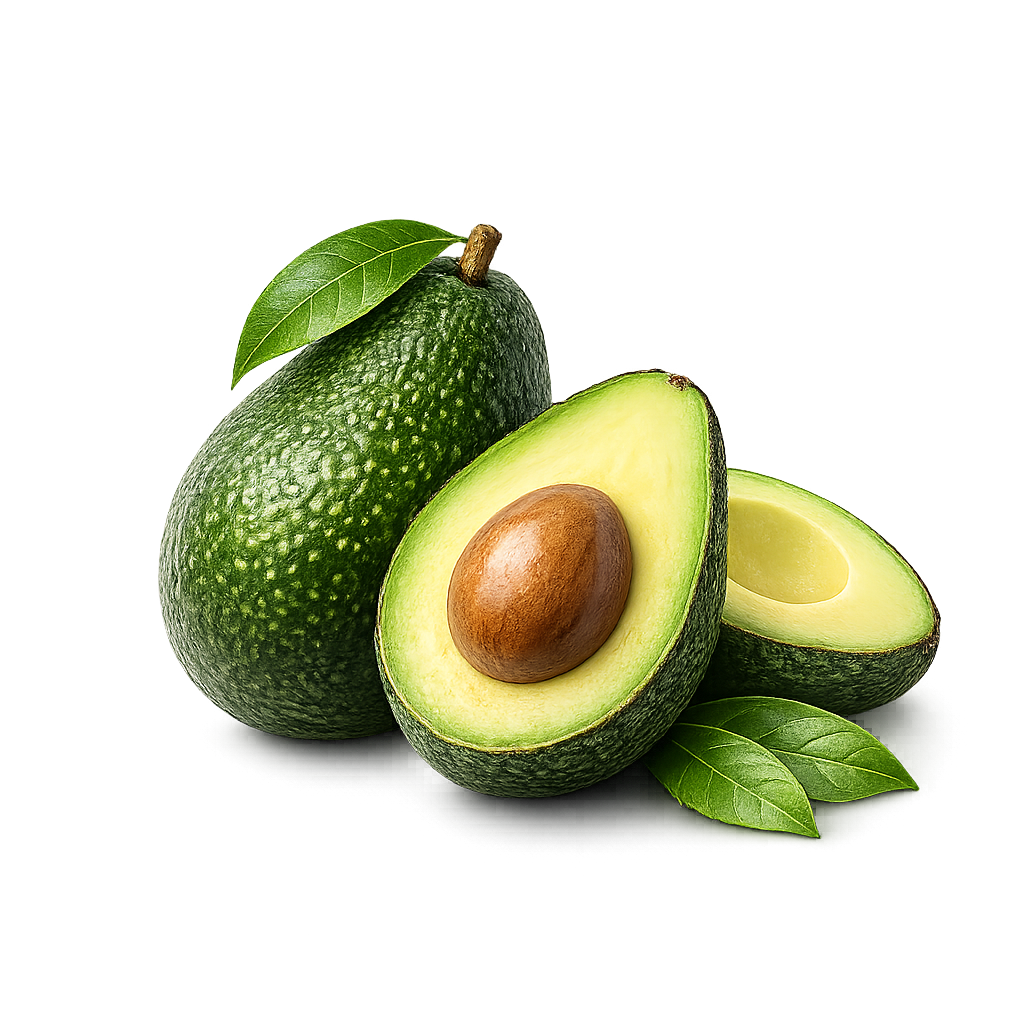
🥑 Raw avocado provides 160 kcal per 100g, with 15g healthy monounsaturated fat and 7g fibre. Half a medium avocado (75g) contains approximately 120 kcal.
Source: USDA FoodData Central · Raw · Data verified by CaloriesCalc
160
kcal
per 100g, raw
8.53
g
Carbs
2.0
g
Protein
14.66
g
Fat
6.7
g
Fiber
109
kcal half medium (68g)
234
kcal whole medium (146g)
45
kcal per oz (28g)
✔ Rich in healthy fats✔ High in potassium✔ Excellent fiber source✔ Keto-friendly✔ Gluten free✔ Vegan
🥑
🥑rich fruit source of healthy fat
⚡More potassium than banana
🌿high in
✅Keto & low-carb friendly
❤️Improves LDL particle quality
🧠Rich in folate & vitamin B6
🥑 Calculate Calories for Any Avocado Weight
Weight100g
Nutrition Facts
Per 100g (raw avocado)
* % Daily Value based on a 2,000 kcal diet.
Quick summary: Avocado contains 160 calories per 100g — higher than most fruits — but 77% of those calories come from monounsaturated oleic acid, the same healthy fat found in olive oil. Half an avocado (68g) provides 109 calories, 10% of daily potassium (more than banana), 24% of folate, and 4.6g of fiber. With only 1.8g of net carbs per 100g, avocado is one of the most keto-friendly and diabetes-friendly foods available.
Vitamins & Minerals — per 100g
Nutrient
Amount
% Daily Value
Bar
Folate (B9)
81 µg
20%
Vitamin K
21 µg
18%
Potassium
485 mg
10%
Vitamin B6
0.26 mg
15%
Vitamin C
10.0 mg
11%
Vitamin E
2.07 mg
14%
Copper
0.19 mg
21%
Magnesium
29 mg
7%
Niacin (B3)
1.74 mg
11%
Pantothenic (B5)
1.39 mg
28%
Calories in Avocado by Weight
Weight
Calories
Carbs
Protein
Fat
Calories in Different Avocado Servings
Serving
Weight
Calories
Carbs
Net Carbs
Fat
1 oz (2 tbsp)
28g
45 kcal
2.4g
0.7g
4.1g
⅓ medium avocado
50g
80 kcal
4.3g
1.2g
7.3g
⭐ Half medium avocado
68g
109 kcal
5.8g
1.6g
10.0g
1 whole medium avocado
146g
234 kcal
12.5g
3.5g
21.4g
1 cup sliced
146g
234 kcal
12.5g
3.5g
21.4g
2 tbsp guacamole
30g
48 kcal
2.6g
0.7g
4.4g
How does avocado fit your daily calorie goal?
Calculate your TDEE to see exactly how it fits your daily budget
Avocado is unique among fruits — 77% of its calories come from fat. However, 71% of this fat is monounsaturated oleic acid (the same as olive oil), which is strongly associated with cardiovascular health. Net carbs are only 1.8g per 100g, making avocado exceptionally keto-friendly.
Micronutrient Highlights
⚡
Potassium
485 mg
10% Daily Value
More than banana (358mg) — blood pressure & heart
🌿
Fiber
6.7 g
24% Daily Value
Highest fiber content of any common fruit
🧠
Folate (B9)
81 µg
20% Daily Value
Essential for cell division & DNA
💊
Vitamin B6
0.26 mg
15% Daily Value
Brain health & neurotransmitters
🛡
Vitamin C
10.0 mg
11% Daily Value
Immune support & antioxidant
🏋
Magnesium
29 mg
7% Daily Value
Muscle function & energy production
Avocado Health Benefits & Nutrition
Monounsaturated Fat — the Healthy Fat in Avocado
Avocado contains 14.7g of fat per 100g, but 71% of this is oleic acid — the same monounsaturated fat that makes olive oil health-promoting. A landmark 2015 study in the Journal of the American Heart Association found that eating one avocado daily reduced LDL cholesterol by 13.5 mg/dL compared to a low-fat diet — and specifically improved LDL particle size from small (dangerous) to large (benign). This was the first randomised trial to demonstrate avocado's cardiovascular benefits.
More Potassium Than Banana
Avocado contains 485mg of potassium per 100g — 35% more than banana (358mg/100g). A whole avocado provides 975mg of potassium — 21% of the daily value. Adequate potassium intake is one of the most consistently supported dietary factors for blood pressure reduction. The Dietary Approaches to Stop Hypertension (DASH) diet is built partly around potassium-rich foods like avocado.
Fiber — the Highest of Any Common Fruit
Avocado provides 6.7g of fiber per 100g — by far the highest of any commonly eaten fruit. This includes both soluble fiber (which feeds beneficial gut bacteria and lowers cholesterol) and insoluble fiber (which promotes bowel regularity). A half avocado provides 4.6g of fiber — 16% of the daily requirement — in a single serving.
Avocado and Weight Management
Despite being calorie-dense at 160 kcal/100g, avocados are consistently associated with better weight management in population studies. A 2013 study in Nutrition Journal found that people who ate avocado reported 23% greater meal satisfaction and had a 40% reduced desire to eat over 5 hours compared to those who didn't. The combination of fat, fiber, and low net carbs creates powerful satiety per calorie consumed.
Avocado contains 160 calories per 100g. Half a medium avocado (68g) has 109 calories. A whole medium avocado (146g) has about 234 calories. Use the slider above to calculate for any weight.
Is avocado good for weight loss?
Yes, in appropriate portions. Despite being calorie-dense, avocado's fat and fiber create strong satiety. Evidence suggests people who eat avocado report greater fullness and consume fewer calories at subsequent meals. The key is portion control — half an avocado is a standard serving.
Is avocado keto?
Yes — avocado is one of the best keto foods. It contains only 1.8g of net carbs per 100g, with 14.7g of healthy fat. It's a staple in ketogenic diets for its fat content, nutrient density, and extremely low carbohydrate content.
Does avocado have more potassium than banana?
Yes. Avocado contains 485mg of potassium per 100g, compared to 358mg in banana. A whole avocado provides 975mg of potassium — 21% of the daily value — making it one of the best dietary sources of this mineral.
Is avocado a fruit or vegetable?
Botanically, avocado is a fruit — specifically a large berry with a single seed. It grows on trees and develops from the flower of the plant. Culinary usage varies: avocado is used as both a vegetable (in salads, sandwiches) and a fruit (in smoothies, desserts).
How much fat is in avocado?
A whole medium avocado contains approximately 21g of total fat. Of this, 15g (71%) is monounsaturated fat (oleic acid), 3g (14%) is polyunsaturated fat, and 3g (14%) is saturated fat. The fat profile is virtually identical to olive oil, which is widely considered one of a nutritious dietary fats.
How do I know when avocado is ripe?
A ripe avocado yields to gentle pressure without feeling mushy. The skin darkens from green to nearly black as it ripens (for Hass variety). Remove the stem nub — if green underneath, it's ripe; if brown, it's overripe; if difficult to remove, it's underripe. Ripen avocados at room temperature, then refrigerate to slow further ripening.