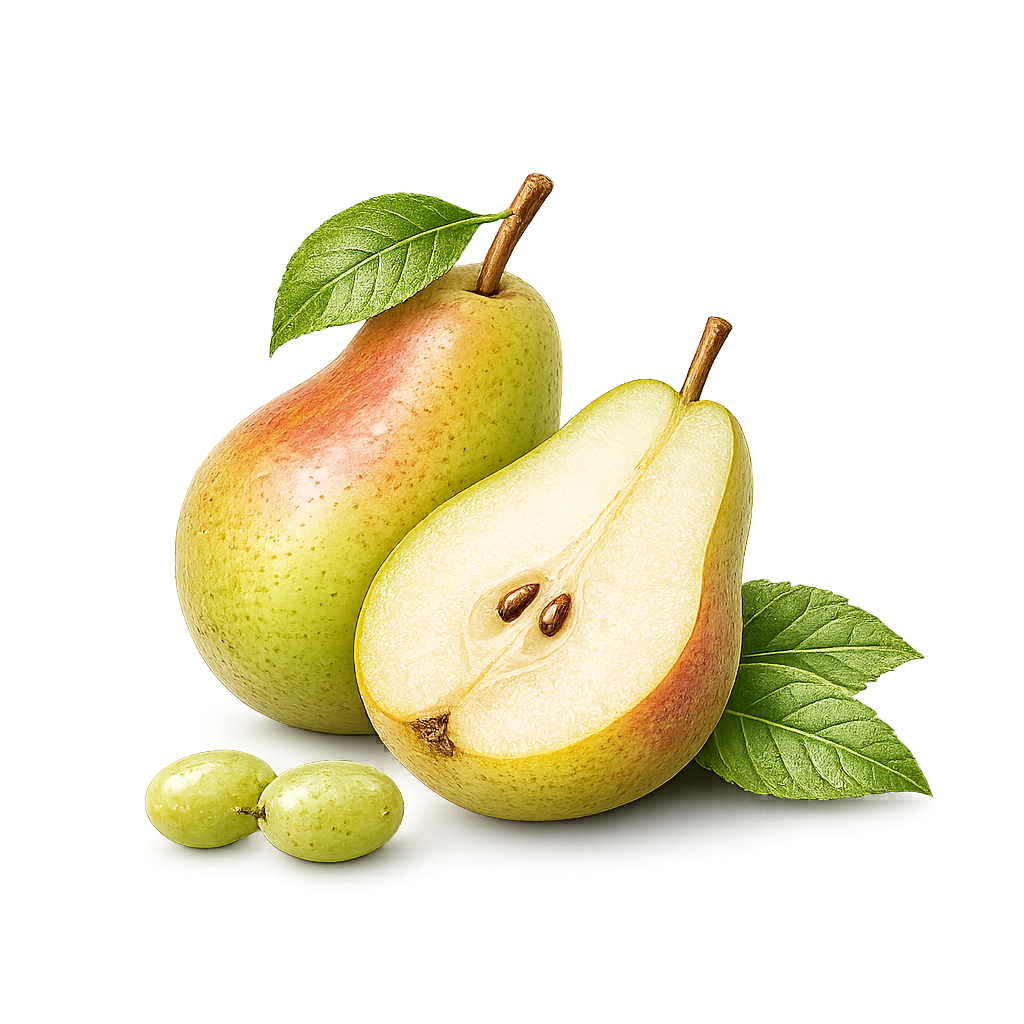
Source: USDA FoodData Central · Raw · Data verified by CaloriesCalc
57
kcal
per 100g, raw
15.23
g
Carbs
0.36
g
Protein
0.14
g
Fat
3.1
g
Fiber
101
kcal per medium pear (178g)
51
kcal per small pear (90g)
16
kcal per oz (28g)
✔ High in fiber✔ Rich in antioxidants✔ Low glycemic index✔ Fat free✔ Gluten free✔ Vegan
🍐
🌿High fiber — 3.1g per 100g
🍃Rich in quercetin and catechin antioxidants
😌Lowest GI of any common fruit — 38
💧84% water content
❤️Linked to reduced heart disease risk
🦴Boron content supports bone health
🍐 Calculate Calories for Any Pear Weight
Weight100g
Nutrition Facts
Per 100g (raw pear)
* % Daily Value based on a 2,000 kcal diet.
Quick summary: Pears contain 57 calories per 100g and 101 calories per medium fruit. They have one of the lowest glycemic indices of any fruit (~38) because their sugars are predominantly fructose. A medium pear provides 22% of daily fiber requirement (mostly pectin in the skin) and significant quercetin and catechin antioxidants. Clinical trials show daily pear consumption reduces blood pressure and LDL cholesterol meaningfully.
Vitamins & Minerals — per 100g
Nutrient
Amount
% Daily Value
Bar
Vitamin C
4.3 mg
5%
Copper
0.08 mg
9%
Potassium
116 mg
2%
Vitamin K
4.4 µg
4%
Folate (B9)
7 µg
2%
Magnesium
7 mg
2%
Vitamin B6
0.03 mg
2%
Calcium
9 mg
1%
Phosphorus
12 mg
1%
Niacin (B3)
0.16 mg
1%
Calories in Pear by Weight
Weight
Calories
Carbs
Protein
Fat
Calories in Different Pear Servings
Serving
Weight
Calories
Carbs
Net Carbs
Fat
1 small pear
90g
51 kcal
13.7g
10.9g
0.1g
⭐ 1 medium pear
178g
101 kcal
27.1g
21.6g
0.2g
1 large pear
230g
131 kcal
35.0g
27.9g
0.3g
1 cup sliced
140g
80 kcal
21.3g
17.0g
0.2g
1 oz
28g
16 kcal
4.3g
3.4g
0.0g
How does pear fit your daily calorie goal?
Calculate your TDEE to see exactly how it fits your daily budget
Pears are 84% water. Their carbs come primarily from fructose — pears have the highest fructose-to-glucose ratio of any common fruit, which gives them a lower GI (~38) than their sugar content might suggest. Net carbs are 12.1g per 100g.
Micronutrient Highlights
🌿
Fiber
3.1 g
11% Daily Value
High fiber — mostly in the skin
🍃
Quercetin
~5 mg
Flavonoid
Anti-inflammatory, heart protective
⚡
Potassium
116 mg
2% Daily Value
Blood pressure support
🛡
Vitamin C
4.3 mg
5% Daily Value
Immune support
🦴
Boron
~0.1 mg
Trace mineral
Bone health and hormone metabolism
🔬
Copper
0.08 mg
9% Daily Value
Iron metabolism and antioxidant defense
Pear Health Benefits & Nutrition
Highest Fructose-to-Glucose Ratio — Why Pears Have a Low GI
Pears are unique among common fruits in having an exceptionally high ratio of fructose to glucose. Unlike glucose, fructose does not trigger an insulin response directly — it is metabolised primarily in the liver. This is why pears have one of the lowest glycemic indices of any fruit (~38), despite containing 9.75g of sugar per 100g. This makes pears an excellent fruit choice for people managing blood sugar.
Fiber — Mostly in the Skin
Pears contain 3.1g of fiber per 100g, and a significant proportion — particularly pectin (soluble fiber) and lignin (insoluble fiber) — is concentrated in the skin. Eating a pear with its skin provides roughly 50% more fiber than a peeled pear. A medium pear with skin provides 22% of the daily fiber requirement.
Cardiovascular Benefits
A 2021 randomised controlled trial found that adults who ate two pears daily for 12 weeks had significant reductions in blood pressure (3.5 mmHg systolic) and LDL cholesterol compared to controls. These effects were attributed to pear fiber (which binds bile acids and reduces cholesterol recirculation) and pear polyphenols including quercetin, catechin, and epicatechin.
Boron and Bone Health
Pears are a good dietary source of boron — a trace mineral that plays important roles in bone health, hormone metabolism, and cognitive function. Boron reduces calcium and magnesium excretion through urine, effectively increasing the body's retention of these bone-building minerals. Adequate boron intake is associated with stronger bones and may reduce the risk of osteoarthritis.
Pears contain 57 calories per 100g. A medium pear (178g) has 101 calories. A small pear (90g) has 51 calories. Use the slider above to calculate for any weight.
Should I eat the pear skin?
Yes — pear skin contains a significant portion of the fruit's fiber and antioxidants. Eating a pear with skin provides about 50% more fiber than a peeled pear, plus additional quercetin and polyphenols concentrated in the skin.
Is pear good for weight loss?
Yes. Pears provide 57 kcal per 100g with 3.1g of fiber and 84% water content. Research suggests pear fiber (particularly pectin) slows gastric emptying and increases satiety hormones, making pears effective for appetite control.
Is pear good for diabetics?
Yes — pears are one of the best fruits for diabetics with a GI of approximately 38 (one of the lowest of any fruit). Their sugars are mostly fructose, which doesn't trigger insulin directly. Their fiber further slows sugar absorption.
Is pear keto?
No. Pears have 12.1g of net carbs per 100g. A medium pear (178g) provides 21.6g of net carbs — far too many for a ketogenic diet.
What is the difference between pear varieties?
Common varieties include Bartlett/Williams (yellow-green, juicy, sweet), Bosc (brown, firm, nutty), Anjou (green or red, mild), and Conference (green, elongated). Calorically all varieties are similar (~57 kcal/100g). Bartlett/Williams are the sweetest; Bosc the firmest.